
I told Briar that I'd posted a sexy picture of her on my blog when I posted that pic of her haircut. She thought that it was this one and was all disappointed when it wasn't.
So here it is.
So here it is.
 Mommy and her little boy reading The River Why...
 and admiring the sunset.
  This is the Fire! Truck! Police! Car! The green thing on the top is a light. He makes all kinds of delightfully creative things like this. And is it just me, or (in this picture) does he kind of resemble the crazy Sicilian guy on The Princess Bride?
  A front view. Notice the wad of blankets on the floor behind him. That is where he sleeps, all snuggled up to the crack under the door. I swear to you, people, he does have a bed.
 Examining some little bit of something he picked out in the garden.
 Soren occasionally puts both his legs down one pant leg and declares, "I'm a merboy!" I should really take a photo for posterity. Or blackmail. (Insert evil laugh here.)
 Soren's getting to that age where you start to hear yourself coming out in the things he says. Some of it makes me feel a little bad, like when he calls Liam a "nuisance" or tells one of his little friends, "And don't do that ever again!" Some of it is just funny, like when someone asks him how he's doing and he responds, "Very well." Or when something surprises him and he exclaims, "Good heavens!" And some of it is good. He often give me choices: "Mommy? Do you want to walk or run? Which one? Do you want a red block or a green block? Which one?" I was particularly pleased one evening when I was feeling quite sick and Soren pulled his Lightning McQueen folding chair up to the couch where I was lying. He took my hand, saying, "It's okay. I a doctor. I keep you. I sorry you're sick. You want a story?" (He wound up climbing all over me, repeatedly asking questions about why I wasn't feeling well, what kind of bug it was that made my tummy feel sick, why a bug would do that, etc, etc, and generally not assisting in the healing process in any way, shape, or form....but the thought was nice.)


 Abraham tries to read to Liam once a day, just to see the grin that immediately lights up his face when he sees a book coming his way. He also likes to look at stories when he's alone. He'll happily babble out his own made-up words as he turns the pages.
 I sure love you, Liam.


 The Birthday Boy with his first birthday wish.
 The Birthday Boy with me doing my best to look like Angelina Jolie.
 Hillary and Briar gave Abe these lovely matching "Thinker" bookends.
 I gave Abe a little statuette of a daddy with a baby.
 I think he liked it.
 Abe and Soren blew out the candles on his Macaroni and Cheese.
 And then Abe took a moment to show us how it feels to be getting old.
 Quentin dyed Briar's hair a dark red. Isn't it sexy? Also, isn't that a fabulous haircut?
 Set in a medeival-esque fantasy land, On Fortune's Wheel tells the story of a young woman named Birle who, restless in her workaday life as an innkeeper's daughter, chances upon a young lord who is running away from his own responsibilities to the mysterious lands of the south. She swears herself into his service and follows him downriver, into all kinds of adventure. The journey (of course) is also a journey of growth and self-discovery for Birle, who grows from childhood, into a lover, and finally into an independent and strong young woman.
 Quentins is supposed to be centered around a restaurant-- the people who run it, the people who eat there, the life events that happen within its walls.


 Doesn't he look so handsome and ridiculously grown-up?
 Soren woke me up one morning by calling from his room, "Mommy! There's a baby in my belly!" I opened the door and saw this.
 Modeling my Scenic River Classic 5K t-shirt.
  Soren loves his Grandma. I would also love anyone who always let me have my own way.
 You can almost hear him screaming, "NO! IT'S MY TOY! DON'T TOUCH IT!"
 Media really can bring us together.
 Baby, 16 months, seeks companion, 9-18 months, for parallel play.
 SWM, two feet tall, thirty pounds: chubby, cuddly, jovial, sweet.
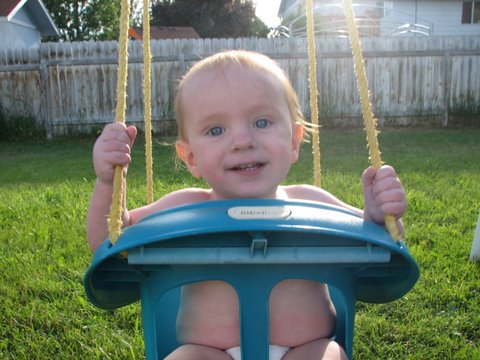 Enjoys flinging sand across the sandbox, splashing in the bathtub, hearing stories read aloud,
 playing pat-a-cake, cuddling, trying new foods,
 and examining objects from all angles.
 Does not enjoy waiting for bottles.


